
How Systems Fail Quietly
An in-depth analysis of how complex systems fail quietly, why structural drift precedes collapse, and what strategic leaders must monitor before breakdown becomes visible.
SYSTEMIC RISK
Patrick K. Gruél
2/18/20264 min read
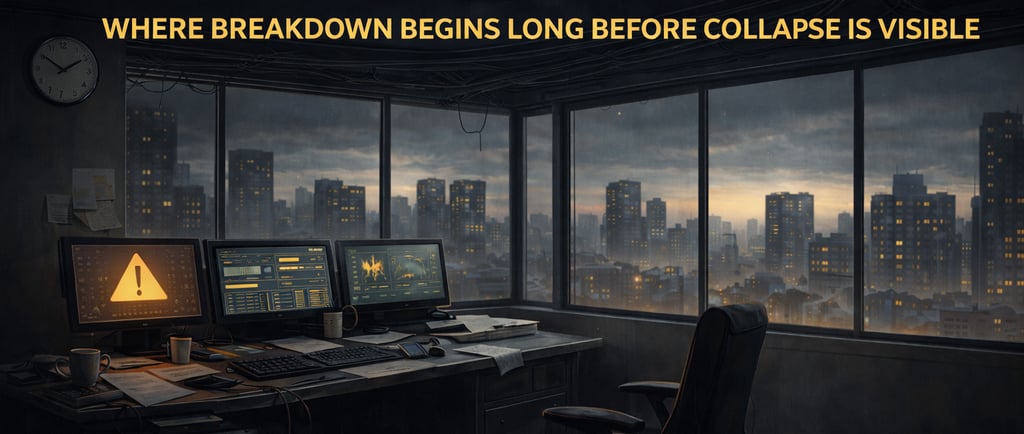
Where breakdown begins long before collapse is visible.
Collapse is rarely sudden. It only appears that way to those who weren’t paying attention.
Systems do not fail when they break. They fail when their internal logic begins to drift from reality — quietly, incrementally, almost politely. The visible collapse is merely the final expression of long-accumulated structural misalignment.
The most dangerous failures are not explosive. They are silent.
The Illusion of Stability
Every functioning system creates the perception of permanence. Markets trend. Institutions operate. Supply chains deliver. Platforms scale. Governance structures regulate.
Performance metrics stabilize. Revenue grows. Friction declines.
Stability becomes narrative.
But stability is not proof of resilience. It is often proof of inertia.
Systems fail quietly when short-term outputs remain intact while long-term structural integrity erodes. A corporation may report record profits while cultural decay spreads internally. A financial system may exhibit low volatility while leverage accumulates invisibly beneath the surface. A political order may appear functional while legitimacy quietly evaporates.
In complex environments, breakdown does not begin with collapse. It begins with drift.
Drift: The Invisible Beginning
Drift occurs when a system continues operating under assumptions that are no longer true.
Incentives misalign.
Feedback loops weaken.
Risk models become outdated.
Information asymmetries widen.
Decision speed decouples from environmental change.
Yet performance indicators may still look acceptable.
This is the first phase of quiet failure: functional appearance with structural decay.
Most leaders miss this stage because it does not trigger alarms. There is no headline. No dramatic rupture. No sudden loss.
Only a subtle widening gap between what the system believes about itself and how the environment is evolving.
Drift is tolerated because it is profitable.
Until it isn’t.
Efficiency vs. Resilience
Modern systems optimize for efficiency.
Efficiency reduces redundancy.
Redundancy appears wasteful.
Waste reduces margins.
Margins drive valuation.
So buffers disappear.
Supply chains become lean.
Financial systems become interconnected.
Technology stacks become centralized.
Governance models become streamlined.
This works beautifully — until variability returns.
Resilience, unlike efficiency, requires slack. Optionality. Redundancy. Strategic friction.
But resilience is invisible when nothing breaks. It becomes politically and economically difficult to justify.
Quiet failure begins when efficiency crowds out resilience.
The system becomes brittle.
Brittleness hides beneath smooth performance curves.
Incentive Distortion
Incentives are the hidden architecture of every system.
When incentives shift, behavior shifts. When behavior shifts, structure eventually follows.
Consider:
Financial executives compensated for short-term returns.
Political leaders rewarded for quarterly optics.
Tech companies incentivized for user growth over systemic integrity.
Corporations prioritizing buybacks over long-term capital formation.
None of these decisions appear catastrophic individually. Each makes sense locally.
But collectively, they rewire system behavior.
Over time, systems become optimized for optics rather than robustness. Signaling replaces substance. Reporting replaces reality.
Quiet failure begins when incentives reward surface stability while penalizing structural honesty.
Signal Degradation
Healthy systems depend on accurate feedback.
Price signals.
Voter sentiment.
Customer churn.
Employee morale.
Liquidity flows.
When signals become distorted — through manipulation, suppression, over-intervention, or data overload — leaders lose situational awareness.
In financial markets, excessive liquidity can suppress volatility, masking underlying risk concentration. In organizations, excessive internal messaging can obscure real cultural fractures. In geopolitics, controlled narratives can conceal eroding legitimacy.
When signals degrade, leaders misread stability for strength.
The system continues operating — but blind.
Quiet failure accelerates when information quality declines.
Complexity Without Comprehension
Modern systems are deeply interconnected.
Finance links to geopolitics.
Supply chains link to energy flows.
Technology links to cognitive behavior.
Monetary policy links to asset inflation.
Interconnection increases efficiency and scale. But it also increases contagion risk.
The greater the complexity, the harder it becomes for any single actor to fully comprehend system exposure.
This produces an illusion of distributed risk.
In reality, risk concentrates in invisible nodes.
When complexity exceeds comprehension, small perturbations can trigger nonlinear outcomes.
But long before collapse, systems enter a state of fragile equilibrium — stable under normal conditions, unstable under stress.
The danger lies in misjudging the transition threshold.
Cultural Decay as Precursor
Systems are not purely mechanical. They are cultural.
When accountability erodes, decay begins.
When dissent is punished, decay accelerates.
When institutional memory fades, decay compounds.
Cultural breakdown precedes structural collapse. It manifests in subtle ways:
Risk warnings ignored.
Whistleblowers sidelined.
Overconfidence institutionalized.
Historical lessons dismissed as outdated.
The system continues to operate. Performance continues. Reputation remains intact.
But internal truth deteriorates.
And when truth deteriorates, decision quality follows.
Liquidity as Sedative
Excess liquidity often masks systemic fragility.
Capital inflows compress spreads.
Asset prices inflate.
Volatility declines.
Liquidity acts as a sedative — numbing risk perception.
But liquidity does not eliminate structural imbalance. It only postpones recognition.
The longer the postponement, the greater the adjustment.
Quiet failure often hides inside abundance.
The Tipping Illusion
By the time collapse becomes visible, it is often already irreversible.
From the outside, collapse appears sudden. From inside the system, it was gradual.
Leverage accumulated.
Trust eroded.
Incentives distorted.
Feedback weakened.
Redundancy eliminated.
The tipping point is not where failure begins. It is where accumulated drift becomes undeniable.
The visible event — bankruptcy, market crash, institutional crisis, geopolitical rupture — is merely the disclosure.
Breakdown began years earlier.
What High-Level Decision-Makers Must Recognize
For leaders operating at capital, institutional, or geopolitical scale, the critical question is not: “Is the system stable?”
It is:
Where is structural drift accumulating beneath apparent performance?
To answer that, decision-makers must examine:
Incentive alignment
Feedback integrity
Redundancy levels
Cultural resilience
Concentration of invisible risk
Dependency chains
Narrative vs. measurable reality
True strategic intelligence is the ability to detect early erosion — before collapse forces reaction.
The Discipline of Structural Awareness
Most executives react to visible crises. Few allocate attention to pre-collapse indicators.
Structural awareness requires:
Studying outliers rather than averages.
Tracking volatility suppression rather than volatility spikes.
Investigating incentives rather than stated strategy.
Monitoring signal distortion rather than surface calm.
Maintaining buffers even when they appear unnecessary.
Resilient systems look inefficient during stability phases.
Fragile systems look impressive — until they don’t.
Final Observation
Systems fail quietly because comfort delays correction.
Performance creates confidence.
Confidence creates complacency.
Complacency erodes discipline.
Erosion compounds invisibly.
Collapse is never the beginning.
It is the moment denial ends.
For those responsible for capital allocation, institutional governance, or long-term strategic positioning, the imperative is clear:
Do not monitor collapse.
Monitor drift.
Because by the time failure becomes visible, it is no longer preventable — only manageable.
And management is far more expensive than foresight.
Inspire | Passion | Vision
Contact
Newsletter
© 2025. All rights reserved.
Momentum Circle (Coming Soon)
Editorial & Advertising Policy
GET FEATURED!