
Geopolitical Shifts — Asia’s New Supply Chain Logic
Asia is redesigning supply chains for power, not cost. The new logic reshaping global production.
POWER STRUCTURES
Patrick K. Gruél
2/17/20263 min read

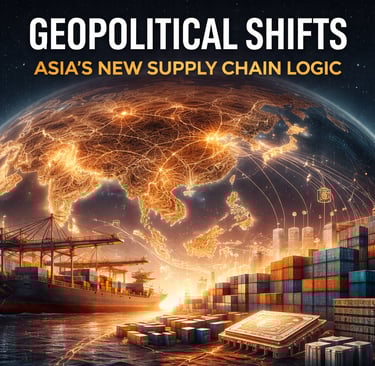
Geopolitical Shifts — Asia’s New Supply Chain Logic
Why capital, control, and regional power are redesigning the architecture of global production
For three decades, global supply chains optimized for one variable above all: efficiency.
Lowest cost.
Fastest scaling.
Maximum integration.
Asia became the gravitational center of this architecture — first through labor arbitrage, then through industrial clustering, and ultimately through technological specialization.
That era is closing.
We are now witnessing the redesign of supply chains not around cost, but around control.
And Asia is once again the epicenter.
From Globalization to Strategic Regionalization
The old model was linear:
Raw materials → China-based manufacturing → Western consumption.
It relied on political stability, cheap logistics, predictable trade relations, and financial integration.
The new model is modular.
Production is no longer optimized solely for margin expansion. It is optimized for resilience, jurisdictional leverage, and geopolitical insulation.
Three forces accelerated this shift:
Trade tensions and tariff escalation
Pandemic-induced logistics breakdowns
Semiconductor export restrictions
Supply chains revealed their hidden fragility.
Capital noticed.
The Rise of Multi-Node Asia
Asia is not decoupling from itself.
It is rebalancing internally.
Instead of China as the dominant manufacturing monolith, we now see:
Vietnam absorbing electronics assembly
India expanding semiconductor ambitions
Indonesia leveraging raw material dominance
Malaysia scaling high-end chip packaging
Japan reinforcing advanced materials leadership
This is not fragmentation. It is distribution. The logic is deliberate:
No single jurisdiction should hold complete supply chain dominance.
Diversification is becoming strategic doctrine.
Capital Follows Security
Supply chains are no longer purely economic instruments.
They are instruments of leverage.
When production of critical goods — chips, rare earths, batteries — is concentrated, it creates political influence.
Therefore, governments across Asia are deploying capital toward strategic redundancy.
Industrial policy has returned.
Subsidies, tax incentives, infrastructure corridors — these are not protectionist reflexes. They are defensive investments.
Sovereignty is being redefined through production capacity.
China’s Strategic Repositioning
China remains central.
But its role is evolving.
Instead of functioning purely as global manufacturer, it is accelerating domestic value chain depth — chip design, EV innovation, battery technology, robotics.
The objective is not isolation.
It is vertical integration.
If external markets restrict access, domestic demand and internal supply networks must compensate.
China’s response to geopolitical pressure is not retreat.
It is internal strengthening.
India’s Structural Opportunity
India’s emergence is not accidental.
Demographics, regulatory reform, and digital infrastructure converge at a strategic moment.
Western corporations seeking diversification from China view India as a scale alternative — not replacement, but complement.
However, India’s advantage will not come from labor cost alone.
It will depend on logistics modernization, legal predictability, and energy reliability.
Supply chain logic rewards consistency.
Capital allocates where long-term coordination appears credible.
The Semiconductor Axis
No supply chain discussion is complete without semiconductors.
Advanced chips are the nervous system of the modern economy.
Taiwan remains critical. South Korea maintains technological leadership. Japan controls materials. The United States controls key design IP.
This interdependence creates tension.
Export restrictions reveal how quickly geopolitical friction can cascade through production ecosystems.
Asia’s new supply chain logic therefore prioritizes redundancy in chip fabrication, packaging, and materials.
Compute capacity is national leverage.
And Asia is racing to secure it.
Energy as Hidden Variable
Manufacturing scale demands energy.
As Asia restructures production corridors, energy security becomes central.
Countries investing in renewable infrastructure, grid stability, and LNG diversification gain competitive advantage.
Energy volatility directly translates into supply chain instability.
The new logic integrates energy independence into production planning.
The End of Pure Efficiency
The most profound shift is philosophical.
Efficiency is no longer supreme.
Resilience has monetary value.
Redundancy now commands premium.
Companies once penalized for over-diversification are rewarded for risk mitigation.
Margins may compress slightly.
Strategic durability expands.
Capital markets increasingly understand this tradeoff.
Financial Implications
For investors, Asia’s new supply chain logic creates layered opportunity:
Infrastructure development
Logistics platforms
Semiconductor ecosystems
Advanced materials
Energy storage
But beyond sector exposure lies structural insight.
Regions aligning policy with production security will attract long-duration capital.
Fragmented governance structures will struggle.
Supply chains follow stability.
The Long-Term Pattern
Historically, supply chains concentrate until vulnerability becomes visible.
Then they disperse.
The British Empire concentrated trade.
The United States industrialized domestically.
China centralized manufacturing.
Each cycle responded to previous structural fragility.
Asia’s current transformation represents the next reconfiguration.
Not collapse.
Rebalancing.
Strategic Conclusion
Asia is not retreating from globalization.
It is redefining it.
The next decade will not be shaped by a singular manufacturing superpower.
It will be shaped by distributed production networks anchored in Asia, optimized for geopolitical durability rather than maximal efficiency.
For strategic leaders, the lesson is clear:
Supply chains are no longer operational questions.
They are power questions.
And those who understand the new logic early will not simply adapt to geopolitical shifts.
They will position capital ahead of them.
Inspire | Passion | Vision
Contact
Newsletter
© 2025. All rights reserved.
Momentum Circle (Coming Soon)
Editorial & Advertising Policy
GET FEATURED!